


Category: News

From Policy to Practice: Workforce Pell will not deliver itself

Workforce Pell, sometimes called “short-term Pell,” expands Pell Grant eligibility to short-term, career-focused training programs. It will take effect July 1, and states are eagerly awaiting final federal rules. This is a pivotal shift in the workforce development and higher education ecosystem, and one that has the potential to help learners and job seekers access new, high-quality career pathways that allow them to thrive. What happens in the next 60 days will determine how this policy lands in practice.
Across the country, states and institutions are making near-term decisions that will shape how this new era of workforce development will impact career pathways for years to come. In working alongside partners in state and local government during this planning phase, we see a consistent pattern: success will depend less on policy design and more on execution.
Workforce Pell implementation is as much a systems-building effort as it is a financial aid or programmatic one. States best positioned to implement and scale Workforce Pell are those that connect it to broader career pathways aligned to future jobs. There must be a foundation of collaboration across state agencies, colleges, and employers. The question then is how to build that foundation quickly.
Enabling Conditions for Strong Implementation
The strongest lever is cross-system alignment and accountability grounded in a clear statewide or regional strategy, aligned with labor market growth and demand. Workforce Pell will work best where governors’ offices, workforce agencies, higher education leaders, colleges, and employers are aligned around a common implementation model. That kind of alignment is already emerging in the places we are working, where state officials have been cultivating relationships like these for months and in many ways. We are seeing a significant level of coordination in states like South Carolina, where strong connectivity between state government and education institutions has allowed for open and honest communication about critical policy decisions, like how to define “high-skill, high-wage or in-demand” occupations, and has opened the door for discussion of how to incorporate dual-enrollment effectively into the equation.
A second major lever is clear prioritization through focused planning around a manageable set of high-opportunity programs or sectors. Rather than trying to do everything at once, successful rollout will most often focus first on credentials that are clearly tied to employer demand and strong earnings potential. State leaders need to be realistic about the number of programs that can realistically be included as eligible this year thinking about the available supply of talent, the demand for jobs supported by eligible programs, and the ability for Pell eligible populations to take advantage of the opportunities as the state makes them available. We are seeing that it is better to start small, and to plan to scale eligibility in years to come.
A third lever is building the practical implementation infrastructure early. That includes policy development, data transparency and portability, clear rollout plans, Year 1 workplans, learning agendas, and stronger grant management capacity.
Disciplined Implementation
This level of alignment does not happen organically. It requires intentional governance, clear accountability, and sustained coordination. In the states where we are seeing early momentum, like Maryland and North Carolina among others, this alignment is already being actively built and managed.
States that try to stand up Workforce Pell across too many programs or sectors at once risk diluting impact and overwhelming implementation capacity. The strongest early efforts will prioritize a small number of high opportunity pathways where there is:
- Clear employer demand and buy-in from the private sector
- High potential for strong wage outcomes
- Existing training provider capacity
This is not about limiting ambition, but about sequencing it. Early wins in a few sectors can build the political and operational momentum needed to expand over time.
The Next 60 Days
As Workforce Pell moves from policy to practice, the question facing many leaders is not what to do, but how to sequence the work.
The next 60 days offer a critical opportunity to build implementation muscle early. Success will depend on the ability to align quickly, prioritize effectively and put in place the core infrastructure needed to deliver.
- Days 1–30: Translate Strategy into Decisions → Move from alignment to concrete design choices
- Days 30–60: Build Readiness and Launch → The goal is not perfection, but readiness to execute and improve.
States that use this window to align, prioritize, and build implementation infrastructure will not only be ready for July 1, but will be positioned to sustain and scale impact over time.
What We’re Watching
As the federal rulemaking process proceeds, we will be tracking the following points closely:
- Pell / state funding interaction; interpretation of “last dollar” nature of Workforce Pell
- States’ application of eligibility requirements
- Where the US Department of Education lands on what percentage of course hours could be provided by non-Title IV institutions
The Bottom Line
Leaders in the workforce development and education space have been discussing how to facilitate greater access to short term training programs, and now those discussions are becoming material. Leaders across the public, nonprofit and private sectors are coming together to bring this policy to life, and the way that it is implemented will be consequential. This policy has the potential to address persistent talent gaps across key industries for decades, centering workers and putting them on the path toward durable, meaningful careers. These are the kinds of opportunities that change the trajectory of entire communities for generations.
The policy window is open. The question now is how states will support learners as they turn access into outcomes.
We are continuing to work with states and partners on early Workforce Pell implementation and would welcome the opportunity to connect with others navigating this shift. Please reach out to us at info@communityfundingaccelerator.org!
CFA Celebrates Women’s History Month

In celebration of Women’s History Month, we want to highlight the inspiring women leaders that we have collaborated with to enhance education and career paths nationwide. These women are courageously driving change, expanding access to opportunity, and boosting economic mobility within their communities. Their remarkable journeys remind us of the power of collective action in creating solutions that support individuals from cradle to career. Read more about their work below.
Catherine Armstrong – The Textile Innovation Engine of North Carolina
Catherine has played a key role in strengthening North Carolina’s textile innovation ecosystem by leading the development of a new, industry-aligned Career and Technical Education (CTE) curriculum for the state. Her work brings together education and industry partners to ensure students gain the technical knowledge and applied skills needed in modern textile manufacturing. Through this effort, she is helping build a stronger talent pipeline for one of the state’s most important and evolving sectors.
Lacy McManus – FUEL (Future Use of Energy in Louisiana)
Lacy is leading efforts through FUEL to expand high school students’ access to high-quality work-based learning and industry-valued credentials in the energy sector across Louisiana. She is working closely with schools, employers, and state partners to align career pathways with workforce demand, ensuring students graduate with both academic preparation and tangible workforce assets. Her leadership is helping create clearer, more equitable on-ramps to high-wage, high-demand careers, by connecting classroom learning to real-world opportunity.
Suzy Diaz – Yakima Valley Partners for Education (YVPE)
Suzy is driving YVPE’s efforts to improve educational outcomes for all youth in Yakima Valley, Washington, from cradle to career. She partners with local K–12 systems, postsecondary institutions, and community-based organizations to ensure students and their families have the knowledge, skills, and resources needed to progress through K–12 and successfully advance to and through postsecondary education and careers. Her work is helping build a more connected education pipeline, increasing educational attainment and opportunity across communities in Yakima Valley.
Allyson DenBeste – Nebraska Department of Education
Allyson DenBeste is an accomplished educator and administrator serving as Academic Officer overseeing Content Area Standards and Instruction for the Nebraska Department of Education. CFA partnered closely with Allyson and the team she led to apply for and implement Nebraska’s first-ever Comprehensive Literacy State Development (CLSD) award. Through this collaboration, NDE secured $55 million to advance statewide literacy, aligning high-quality instructional materials, educator training, and resources to improve outcomes for more than 230,000 students. Her leadership is helping drive a bold, systemwide vision for literacy across Nebraska.
Katherine Tarca – Massachusetts Department of Elementary and Secondary Education
Katherine Tarca is an experienced district- and network-level academic leader with deep expertise in K–8 literacy and a passion for curriculum and instruction. CFA partnered with Katherine to successfully secure a $38 million 2025 CLSD grant, positioning Massachusetts DESE to reach 34,000 students through coordinated, high-impact literacy initiatives. Katherine also helped lead the successful application for a $10 million Education Innovation and Research grant, expanding access to multi-year, high-quality tutoring for 2,430 additional students beginning in first grade.
Dr. Stacey Moore – Carolinas Engine for Grid Modernization
As President of York Technical College, Stacey is spearheading the workforce strategy for the Carolinas Engine for Grid Modernization, a regional effort to strengthen grid resilience and grow advanced energy manufacturing across North and South Carolina. She is mobilizing a cross-sector coalition of technical colleges, universities, employers, and workforce partners to build responsive training programs aligned to rapidly evolving industry needs. Through expanded apprenticeships, stackable credential pathways, and targeted outreach in priority communities, her leadership is accelerating access to in-demand careers while ensuring employers have the skilled talent needed to power grid innovation.
Archie Stewart – City of Birmingham Recompete Initiative
Archie Stewart is driving the delivery of a $20M investment from the EDA as Reinvest Plan Officer of the Reinvest Birmingham Project: a people-centered strategy to expand access to economic opportunity across the City. With nearly a decade of experience in workforce development, Archie brings a strong ability to turn strategy into action, working across government, education, and workforce systems to align partners around a shared vision. Her work focuses on ensuring that Birmingham’s Recompete investment delivers real results for residents—especially in four communities that have faced historical underinvestment—by building clearer, more connected pathways to quality jobs. Through her leadership, Archie is helping reimagine how systems can work together to create lasting, equitable economic mobility.
We are proud to work alongside these trailblazing leaders.
Our 2025 Annual Report is here!
Over the past three years, the Community Funding Accelerator (CFA) has evolved from an ambitious pilot into a proven, evidence-driven platform for community-led change. When we launched the program, our goal was simple but bold: to remove the barriers that keep grassroots organizations from accessing and deploying funding effectively, and to create a pathway for community leaders to drive solutions of their own design. Today, looking back on our journey, we are proud to share just how far this vision has come — and how far our communities have taken it.
From the earliest days of the pilot, we saw clear signs of possibility. Local organizations — many of whom had long been under-served by traditional funding systems — demonstrated resilience and a deep understanding of the needs around them. The CFA platform became a space where their ideas could be tested, strengthened, and scaled. Year by year, the program has expanded its reach, diversified its partners, and refined its model based on real-world learning.
This report highlights the milestones that shaped our growth: the communities we served, the grants we helped apply for and win, the development of robust pathway programs, and the measurable impact of community-designed initiatives. It also captures the stories behind the numbers — stories of community organizations navigating uncertainty, unlocking new capabilities and partnerships, and achieving outcomes that were once deemed out of reach.
Our journey since the pilot has reaffirmed what we believed from the start: when communities are trusted and equipped to lead, the results are transformative. As we move into the next phase of our program, we remain committed to elevating local leadership, strengthening collaboration, and building pathways from cradle to career that make lasting impact not only possible, but inevitable.
We are grateful to every participant, partner, and champion who has contributed to CFA’s growth. This report is, above all, a reflection of your dedication and your belief in the power of community-driven change.
CFA and Yakima Valley Partners for Education Team Up to Seek Funding for Educational Support in the Yakima Valley

Birmingham, Community Partners Meet to Develop Strategy for $20 Million Job Training Grant
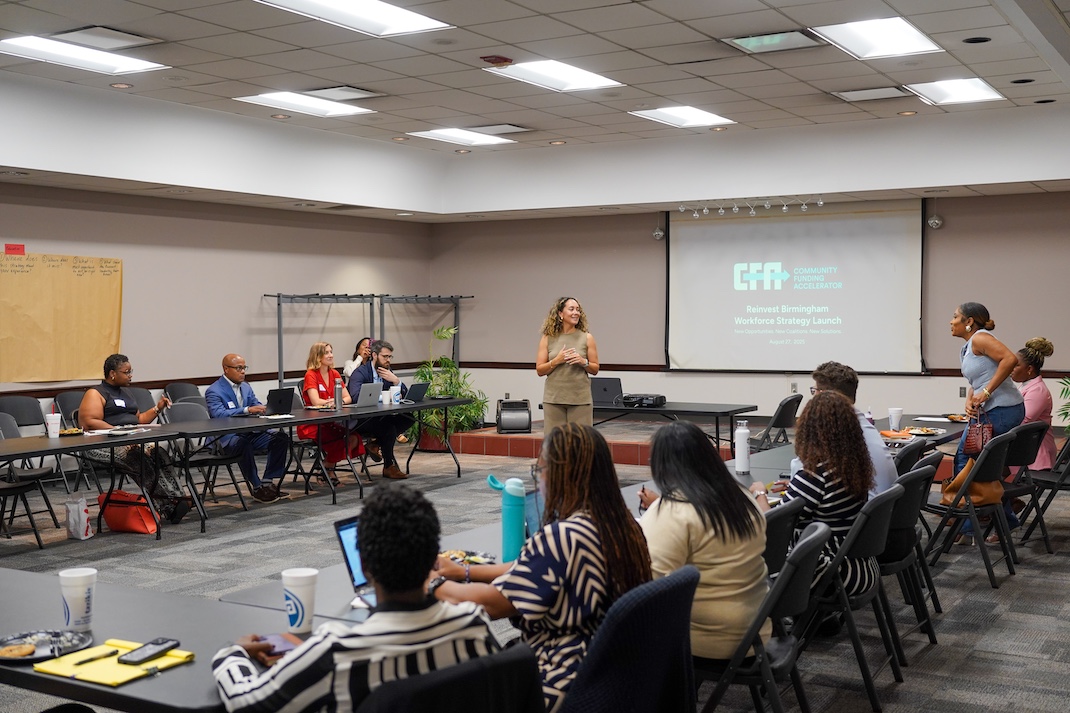
The City of Birmingham, in partnership with the Community Funding Accelerator (CFA), convened 30 employer and community partners in K-12 education, community college, workforce training, transportation, entrepreneurship, and childcare to confirm and release their Workforce Strategy.
The strategy outlines how $20.2 million from the U.S. Economic Development Administration (EDA) grant will be used to advance the Reinvest Birmingham workforce revitalization initiative. With this funding, the City of Birmingham aims to engage 5,000 residents in North Birmingham, Northside, Pratt, and Smithfield in information sessions and career and job fairs with a goal of enrolling over 3,000 residents into Career Pathway Training.
Read more from Birmingham Times.
Apprenticeship Tennessee Receives $5.9 Million in Federal Funding

Read more from Times News.
Jacksonville Kids Hope Alliance, Community Funding Accelerator Seeking $18 Million For Workforce Development Project

Jacksonville’s Kids Hope Alliance and the Community Funding Accelerator are working to secure $18 million in federal, state and private funds for a workforce development project, the city announced in a Sept. 30 release.
According to the release, the partnership seeks to expand employment and job training opportunities in Jacksonville.
KHA estimates that Jacksonville lags peer cities by about $32 million in spending on career and college preparation compared to peer cities. Jacksonville annually spends around $18 million, while peer cities spend closer to $50 million.
Read the full article from the Jacksonville Daily Record.
FUEL Forges Partnership for Energy Internships

NEW ORLEANS (press release) — The Community Funding Accelerator (CFA) and Future Use of Energy in Louisiana (FUEL) have kicked off a new partnership to strengthen workforce readiness and expand opportunities for K-12 students to explore careers in the energy industry.
Read the full article in Biz New Orleans.
Making Opportunity Real

For far too long, communities like Birmingham, Alabama have been victim to widespread disinvestment. Mara Eala of Community Funding Accelerator and Sarah McMillan of the City of Birmingham believe the only way to fight back is to actively and relentlessly reinvest in community residents of all ages. In particular, focusing economic development on the workforce readiness of current middle and high school students is an essential step towards sustainable, equitable, long-term growth.
As one of six winners nationwide for the U.S. Department of Commerce Distressed Area Recompete Pilot Program, Birmingham will do just that. Read the full op-ed here.